


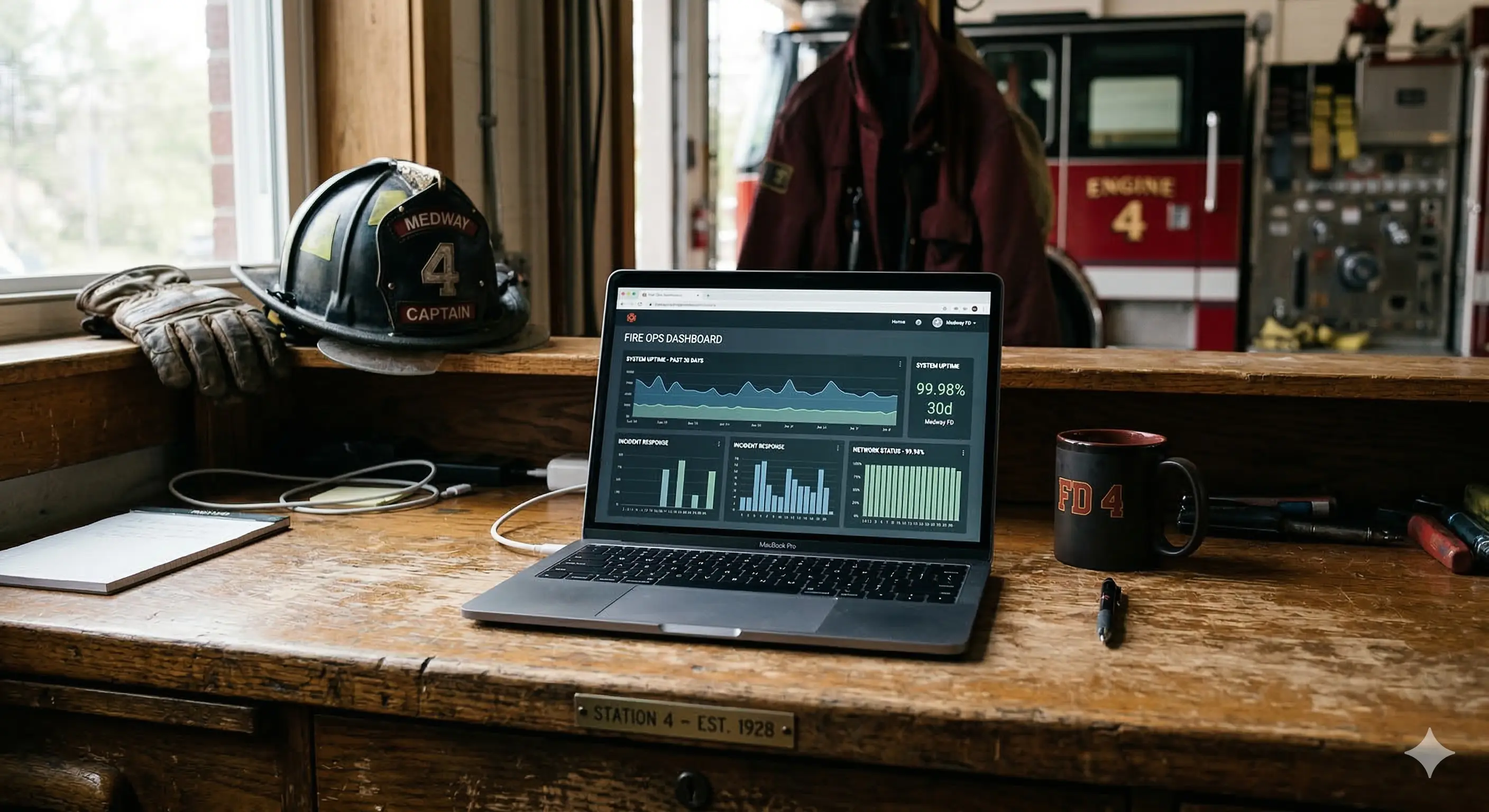

Most Fire Department Websites Are Poorly Hosted
If your fire department website runs slow, goes down unexpectedly, or your department has been hacked before, there is a good chance the problem is not your website -- it is where your website lives.
Fire department website hosting is one of the most overlooked parts of a department's online presence. Most departments end up on whatever cheap shared hosting came with the package when their site was first built years ago. That decision has real consequences for performance, security, and public trust.
This post covers what fire department website hosting actually is, what your department should be looking for, and what to avoid.
What Is Website Hosting?
Every website lives on a server -- a computer that stores your site's files and delivers them to visitors when someone types your address into a browser. Hosting is the service that keeps that server running and your site accessible.
When someone visits your fire department website, their browser sends a request to your hosting server. The speed and reliability of that server determines how fast your site loads and whether it is available at all. Poor hosting means slow load times, downtime, and security vulnerabilities. Good hosting means your site is fast, always available, and protected.
Why Cheap Shared Hosting Is a Bad Fit for Fire Departments
Shared hosting puts your website on the same server as hundreds or thousands of other websites. When another site on that server gets a traffic spike or gets hacked, your site pays the price in speed and stability.
For a business selling t-shirts, a few minutes of slow load time is an inconvenience. For a fire department, it means a resident trying to find your burn permit process, your community safety information, or your emergency contact during an active situation cannot get through.
Your fire department website is public infrastructure. It should be treated like it.
What Good Fire Department Website Hosting Looks Like
99.9% Uptime Guarantee
Your host should guarantee at least 99.9% uptime with a clear SLA behind it. That translates to less than nine hours of downtime per year. Anything lower than that is not acceptable for a public safety organization.
SSL Certificate Included
Every fire department website should run on HTTPS -- the padlock in the browser bar. SSL certificates encrypt the connection between your visitor and your site. Any host worth using includes this by default. If your current site still runs on HTTP, that is an immediate problem.
Daily Automated Backups
Your hosting should back up your entire site daily and store those backups off-site. If your site is ever compromised, you need to be able to restore a clean version quickly. One month of rolling backups is the minimum you should accept.
Security Monitoring
Shared GoDaddy accounts do not watch for malware. Good fire department website hosting includes proactive security scanning, intrusion detection, and rapid response if something is found.
Fast Load Times
Google uses page speed as a ranking factor. Residents will leave a slow site before it finishes loading. Your host should offer server-level caching and be geographically located close to your audience. If your department is on the East Coast and your server is in a data center in California, that gap adds up.
Email Hosting
Many departments run their department email through the same host as the website. That is fine as long as your host supports it properly -- dedicated mail servers, spam filtering, and enough storage for your department's volume. Running department email on a personal Gmail account looks unprofessional and creates record-keeping problems.
Actual Support
When your fire department website goes down at 0200 on a Saturday, you need to be able to reach someone. Check what support channels your host offers and what their average response time looks like. A ticket system with a 48-hour response window is not support.
What to Expect to Pay
Good managed hosting for a fire department website runs between $20 and $60 per month depending on resources and support level. That range gets you dedicated resources, daily backups, security monitoring, SSL, and real support.
If you are currently paying $5-10 per month for hosting, you are on shared hosting and your site is competing for server resources with hundreds of other websites. The upgrade in reliability and security is worth the difference.
How Hosting Works When You Work With The Irons
When a fire department hires The Irons to build their website, hosting is handled for you. We provision your hosting, configure your server environment, set up SSL, enable daily backups, and monitor uptime. You do not touch a server or log into a cPanel.
Ongoing hosting and security monitoring is included in our care plans. If something breaks, we know about it before you do. That is how fire department website hosting should work.
The Short Version
- Cheap shared hosting is not appropriate for a public safety website.
- Look for 99.9% uptime, SSL, daily backups, security monitoring, and real support.
- Expect to pay $20-60/month for hosting that is actually reliable.
- If your site goes down during an emergency, your host is the first place to look.
- Working with a web designer who bundles managed hosting removes the headache entirely.
Questions about your department's current hosting setup? Reach out to The Irons and we will take a look and tell you where you stand.